Posts

Showing posts with the label History of Medicine

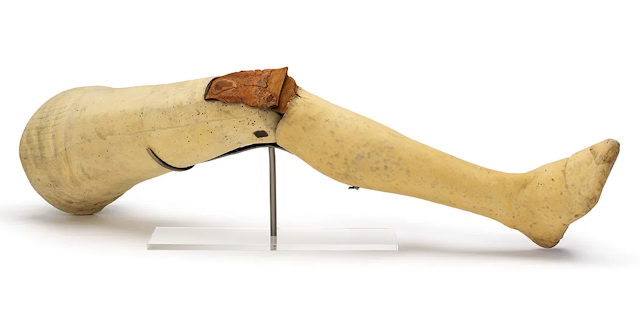
HISTORY OF MEDICINE: The Anglesey Leg
Image
C/W: Contains description of surgery and amputation.  The story of prosthetics is one of human ingenuity.  Based on the existing evidence the earliest entry in this story is of an individual who would eventually be buried near the ancient city of Thebes some time between 950 and 710 BC.  This individual at some point found themselves in need of a replacement big toe, and a prosthetic was made.  Their mummified remains, complete with their prosthetic toe, were discovered in AD 2000, and ten years later a team of biomechanical engineers would discover that the design of the prosthetic was such that it did not require the individual to wear any kind of specialist shoe to hold it in place - they could walk barefoot or in normal Egyptian sandals.  The previous earliest prosthetic we have (or rather had) physical evidence for dated from 300 BC - known as the Capua leg, named for the site of its discovery - it was held by the Royal College of Surgeons, but was destroye...

HISTORY OF MEDICINE: A Plague of Confusion

Image
This article has been slightly expanded upon to provide clarification for those unfamiliar with the epidemiology of the three plague pandemics - which resulted from different strains of the same bacterium.  A few additional edits have been made for the avoidance of confusion by non-specialists in palaeopathology and the archaeology of disease, and to update the article in line with what is currently known about the recent cases in China. It was around 2:00 am when my attention was drawn to a video put out by Bloomberg Tiktok – produced by Matthew Albani and shown below.  The video is a response to news of  cases of 'plague' in China in recent weeks. Is the plague making a comeback?  pic.twitter.com/Hj6DdltGEf — Bloomberg TicToc (@TicToc)  November 20, 2019 Because it was 2:00 am I couldn’t express my initial response out loud without waking my neighbours.    Another video replete with misunderstandings, conflations, and a tone in li...

HISTORY OF MEDICINE / ARCHÆOLOGY: A Question of Ethics and the History of Medicine

This entry is written in response to a question from a student. As a historian one of my research specialisms is in the history of medicine and one of my other research foci is the archaeology of disease and palaeopathology. As such a major part of my research has involved the physical evidence of human existence and interaction with disease - bones. Human remains. And as such there are several highly important ethical considerations in relation to my research. I’ve decided to set out, broadly, the system of ethics I use when it comes to both teaching, writing, studying and also in dealing with a wider audience - both in terms of non-specialists and the general public. I hope that this exposition may prove useful as an, albeit brief, summary of what might be considered good ethical practice. There has bene extensive debate over the display of human remains in the context of museums - given all the associated ethical questions, and the legacy of racism and colonialism with which, ...