Posts

Showing posts with the label Ethics

POPULAR HISTORY: Witchcraft, and Salem-sationalism.
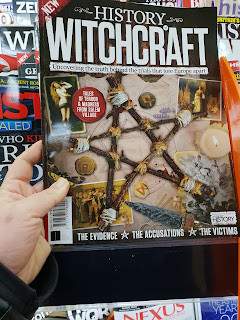
Image
While perusing the magazine racks in my local branch of WHSmith’s, my eyes fell on one title and I let out an inward groan of academic despair. I have to admit I have something of a love hate relationship with popular history magazines. Some are reasonably good, others are terrible. Some are only interesting for the farcical nature of the ‘history’ contained within. The title which drew my attention however, was one which might be considered both ridiculous and at the same time both irresponsible and dangerous. The title, produced by the same imprint which publishes All About History (a title which itself frequently retreads inaccuracies from simplified school history texts), was “History of Witchcraft”. The subtitle makes the bold statement that it “Uncovers the truth behind the trials that tore Europe apart”. As anyone with even a casual scholarly interest in witchcraft or magic is no doubt aware this is a distinctly bold and factually inaccurate claim. Even with this beginning sta...

HISTORY OF MEDICINE / ARCHÆOLOGY: A Question of Ethics and the History of Medicine

This entry is written in response to a question from a student. As a historian one of my research specialisms is in the history of medicine and one of my other research foci is the archaeology of disease and palaeopathology. As such a major part of my research has involved the physical evidence of human existence and interaction with disease - bones. Human remains. And as such there are several highly important ethical considerations in relation to my research. I’ve decided to set out, broadly, the system of ethics I use when it comes to both teaching, writing, studying and also in dealing with a wider audience - both in terms of non-specialists and the general public. I hope that this exposition may prove useful as an, albeit brief, summary of what might be considered good ethical practice. There has bene extensive debate over the display of human remains in the context of museums - given all the associated ethical questions, and the legacy of racism and colonialism with which, ...